Thinking about taking a boating course but want to do it from home? You’re in good company—thousands of boaters now choose online courses over traditional classroom instruction.
But which online boating course should you choose? Are they legally recognized? What’s actually included? And most importantly: will an online course really prepare you to operate a boat safely?
This guide covers everything you need to know about online boating courses, how they compare to in-person options, and how to pick the best one for your needs.
Online Boating Courses: Quick Overview
What You Need to Know:
- ✅ Legally recognized: NASBLA-accredited online courses have the same legal validity as in-person courses
- ✅ Time-efficient: Complete most online courses in 1-2 hours (vs. 4-8 hours for classroom)
- ✅ Affordable: $39.97-$60 online vs. $50-$150+ for in-person classes
- ✅ Flexible: Learn at your own pace, on your schedule
- ✅ Mobile-friendly: Most courses work on phones, tablets, or computers
- ✅ Instant certificate: Digital certificate delivered via email (often within minutes)
Bottom Line: Online boating courses are a smart, efficient alternative to traditional classroom instruction—if you choose the right provider.
Online vs. In-Person Boating Courses: Full Comparison
Cost Comparison
Online Course: $39.97-$60, no hidden fees, low total cost.
In-Person Class: $50-$150+, possible hidden fees, high total cost.
Winner: Online (lower price, no surprises).
Time Commitment
Online Course: 1-2 hours total (any time, self-paced).
In-Person Class: 6-10+ hours total (fixed schedule, travel time).
Winner: Online (significantly faster).
Learning Experience
Online Course: Videos, reading, interactive modules, self-paced, scenario-based learning.
In-Person Class: Instructor lecture, Q&A, discussion, peer interaction, may include hands-on demos.
Winner: Depends on learning style. Visual learners → Online. Social learners → In-Person.
Certificate Validity
Online Course: NASBLA-accredited, valid in FL/CA, accepted by authorities.
In-Person Class: If NASBLA-accredited, same validity as online.
Winner: Tie (both equally valid if NASBLA-accredited).
Convenience & Accessibility
Online Course: Complete anywhere, anytime, works on phone/tablet/computer.
In-Person Class: Requires physical location, fixed schedule, weather-dependent.
Winner: Online (more accessible to more people).
Best Online Boating Courses: Comparison
1. TakeMyBoatTest.com — Best Overall Value
Strengths:
- ✅ NASBLA-accredited (legally valid)
- ✅ State-specific (Florida & California content)
- ✅ Very affordable ($39.97 lifetime)
- ✅ Fast completion (1-2 hours)
- ✅ Instant digital certificate
- ✅ Mobile-friendly platform
- ✅ Friendly, conversational tone
- ✅ No hidden fees or subscriptions
- ✅ Covers all boat types (powerboats, sailboats, jet skis)
Weaknesses: Less brand recognition (newer company), limited video content (more reading-based), no printed certificate included (but digital is accepted everywhere).
Best For: Budget-conscious boaters, self-paced learners, boat renters.
Cost: $39.97 lifetime
Completion Time: 1-2 hours
Certificate: Instant digital delivery
2. National Boating Education Providers
Examples: US Boating, BoatingLicense.org, BoaterEd
Strengths:
- ✅ NASBLA-accredited (legally valid)
- ✅ Well-established brands
- ✅ Comprehensive content
- ✅ Video-heavy format
- ✅ Recognized nationally
- ✅ Good customer reviews
Weaknesses:
- ❌ More expensive ($50-70)
- ❌ Less state-specific (generic content)
- ❌ Longer completion time (2-3+ hours)
- ❌ May include upsells (printed cards, promotional materials)
- ❌ Less mobile-optimized (better on desktop)
Best For: Boaters wanting established brand recognition, comprehensive video content.
Cost: $50-70 lifetime
Completion Time: 2-3+ hours
Certificate: Usually digital + optional printed (extra fee).
3. In-Person Boating Safety Classes
Examples: Local boating schools, community colleges, boat clubs
Strengths:
- ✅ Hands-on instructor interaction
- ✅ Can ask questions in real-time
- ✅ Social experience (meet other boaters)
- ✅ Some include hands-on boat demonstrations
- ✅ Often community-focused
- ✅ May offer ancillary training (defensive boating, advanced topics)
Weaknesses:
- ❌ Much more expensive ($75-150+)
- ❌ Fixed schedule (must attend specific times)
- ❌ Requires travel (location-dependent)
- ❌ Longer time commitment (4-8 hours)
- ❌ Less flexible
- ❌ Weather-dependent (outdoor/outdoor-hybrid classes)
Best For: Hands-on learners, people who prefer face-to-face instruction, local community builders.
Cost: $75-150+
Completion Time: 4-8+ hours
Certificate: Issued on-site or mailed (takes days/weeks).
How Online Boating Courses Work: Step-by-Step
What to Expect
Before You Enroll:
- Choose your provider (NASBLA-accredited, state-specific)
- Verify it’s legal in your state (Florida: myfwc.com approval, California: dbw.ca.gov approval)
- Check reviews and customer testimonials
- Confirm pricing (no hidden fees)
Enrollment:
- Visit course website
- Create account (email, password, name)
- Select your state (Florida or California)
- Confirm age (typically 14+ to operate)
- Pay course fee (usually $39.97-$70)
Course Content (Typically 1-2 Hours):
- Module 1: Boating safety fundamentals (30-45 min)
- Module 2: Required safety equipment (15-20 min)
- Module 3: Navigation rules and right-of-way (20-30 min)
- Module 4: State-specific laws (20-30 min)
- Module 5: Emergency procedures (15-20 min)
- Module 6: Environmental responsibility (10-15 min)
Interactive Elements: Videos explaining key concepts, real-world scenario examples, illustrations and diagrams, knowledge check quizzes within modules, progress bar showing completion.
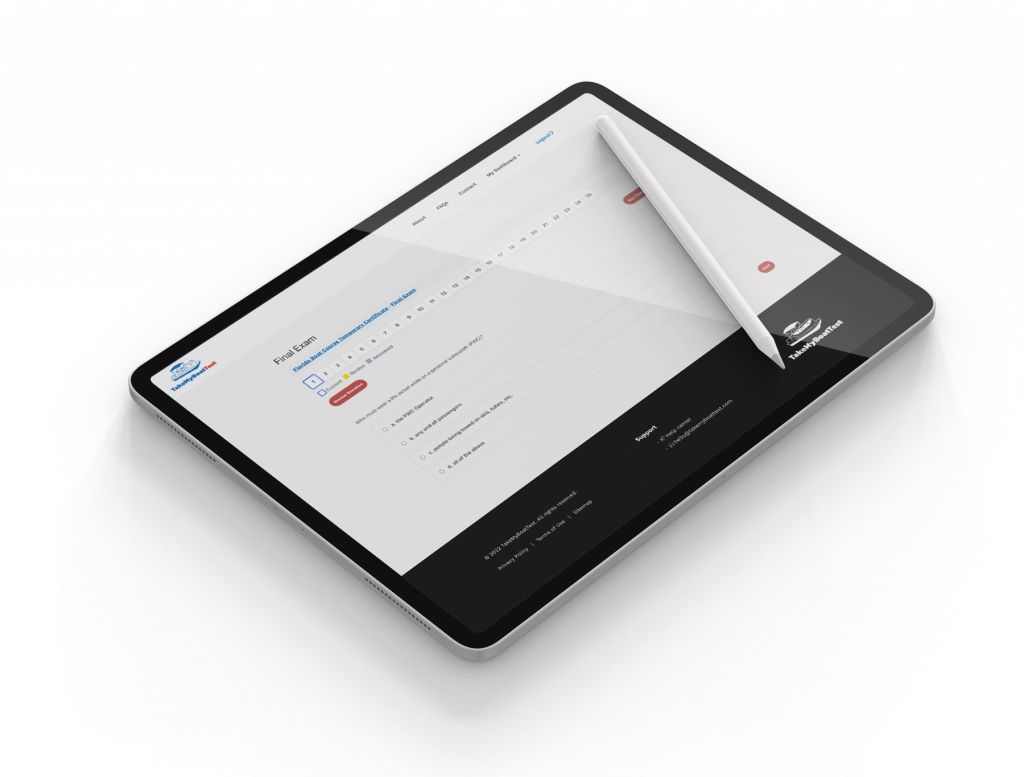
Final Quiz: 10-20 multiple-choice questions, usually 70-80% to pass, most take 10-20 minutes, can retake unlimited times.
Certificate: Digital PDF delivered via email (usually within minutes), can print at home or display on phone, valid immediately in your state, lifetime valid (no renewal needed).
Technical Requirements
Minimum System Requirements:
- ✅ Internet connection (broadband preferred)
- ✅ Computer, tablet, or smartphone
- ✅ Web browser (Chrome, Safari, Firefox, Edge)
- ✅ Email address (to receive certificate)
- ✅ 1-2 hours of uninterrupted time (or flexible, can pause/resume)
Optional: Printer (to print certificate, not required), headphones (some courses have audio, but optional), note-taking app or paper (helpful for studying).
Is an Online Boating Course Right for You?
Choose Online If…
- ✅ You want to save time — Complete in 1-2 hours vs. 4-8 hours
- ✅ You prefer self-paced learning — Start/stop whenever you want
- ✅ You’re on a budget — $39.97 online vs. $100+ in-person
- ✅ You live far from boating schools — No travel required
- ✅ You have mobility limitations — Take the course at home
- ✅ You need instant certification — Get your certificate within hours
- ✅ You’re a visual/reading learner — Videos and interactive modules work for you
- ✅ You need flexibility — Take it whenever it fits your schedule
Choose In-Person If…
- ❌ You’re a hands-on learner — Benefit from instructor interaction
- ❌ You have lots of questions — Want real-time Q&A with an expert
- ❌ You prefer social learning — Meet other boaters, networking
- ❌ You want hands-on boat practice — Some classes include on-water demonstrations
- ❌ You’re uncomfortable with technology — Paper materials and in-person instruction
- ❌ You want printed certificate immediately — Handed to you after class
Online Boating Course Content: What’s Actually Taught?
Standard Topics (All Accredited Courses)
1. Boating Fundamentals – Boat types (powerboats, sailboats, jet skis, pontoons), how boats move and respond to water, center of gravity and weight distribution, steering and propulsion systems.
2. Safety Equipment – Personal flotation devices (life jackets/PFDs), types of PFDs and when to wear each, fire extinguishers on boats, whistles and sound signals, navigation lights, anchoring systems, kill switch/lanyard (critical for jet skis).
3. Navigation Rules – Port (left) vs. starboard (right), navigation rules of the road, right-of-way situations, how to avoid collisions, proper signaling and communication, what to do when encountering other vessels.
4. State-Specific Laws – Florida: Vessel registration, speed zones, manatee protection, age requirements, BUI penalties. California: Boater card requirements, marine reserves, fishing restrictions, speed regulations.
5. Emergency Response – What to do if someone falls overboard, assisting an injured boater, recovery techniques, communication in emergencies, CPR basics (some courses), what to do after an accident.
6. Environmental Protection – Fuel and oil disposal, marine wildlife protection, manatee protection (Florida), marine reserve rules (California), proper trash and waste disposal.
7. Boating Under the Influence (BUI) – Legal alcohol limits, impairment effects on water, why water conditions amplify intoxication, penalties for BUI violations, personal liability for accidents.
FAQ: Online Boating Courses
Q: Is an online boating course as good as an in-person course?
A: Yes, if NASBLA-accredited. Both teach the same required safety knowledge and both are legally valid. Studies show no difference in accident rates between online and in-person certified operators. The main difference is learning style—online suits visual/independent learners; in-person suits hands-on/social learners.
Q: How long does an online boating course take?
A: Most take 1-2 hours to complete. You can do it all at once or spread it across multiple sessions (pause and resume). Some people finish in 45 minutes; others take 2-3 hours depending on how thoroughly they review content.
Q: Can I retake the quiz if I fail?
A: Yes. Most NASBLA-accredited online courses allow unlimited attempts at no additional cost. If you don’t pass, review the material and retake the quiz. Most people pass on their first or second attempt.
Q: What if I don’t have a printer to print my certificate?
A: You don’t need one. Your digital certificate (PDF via email) is just as legally valid as a printed one. You can display it on your phone, keep it in your email, or print it later if you want.
Q: Can I use an old online boating certificate?
A: If it’s NASBLA-accredited and marked “lifetime,” yes. Certificates don’t expire. If your old certificate doesn’t show accreditation or has an expiration date, it may not be valid anymore. Contact the issuing provider if unsure.
Q: Will I learn enough from an online course to be a safe boater?
A: An online course covers all essential safety knowledge required by law. However, knowledge alone doesn’t make you an expert operator. The course teaches theory; actual boating experience teaches practice. Take the online course for required knowledge, then practice with experienced boaters to build practical skills.
Ready to get started with an online boating course? Take the Florida boating course or California boater card course today. 1-2 hours, $39.97, NASBLA-accredited, instant certificate.