What does it take to legally operate a boat in Florida or California? The requirements might surprise you—they’re stricter than you think, and failure to comply can result in serious fines and criminal charges.
This comprehensive guide explains the boating safety certification requirements in both states, what you need to know before getting on the water, and how to get properly certified.
Boating Safety Certification Requirements: Quick Overview
Florida:
- ✅ Operators born after January 1, 1988: Must have NASBLA-accredited boating safety certificate
- ✅ All jet ski operators: Required (no age exemption for PWCs)
- ✅ Cost: $39.97 lifetime (one-time payment)
- ✅ Time: 1-2 hours online
California:
- ✅ All motorboat operators born after January 1, 1988: Must complete boating safety course
- ✅ All sailboat operators: Required (all ages)
- ✅ No age exemption: Even seniors must be certified
- ✅ Cost: $39.97 lifetime
- ✅ Time: 1-2 hours online
Bottom Line: In both states, most boaters need formal safety certification. The requirements exist because:
- 90% of boating accidents involve operators without safety training
- Boating safety education reduces accidents by ~25%
- Proper knowledge prevents deaths and injuries
Who Must Have Boating Safety Certification?
Florida Boating Certification Requirements
Birth Date Rule (The Primary Requirement):
- Born after January 1, 1988: Must have boating safety certificate to operate any motorized vessel
- Born before January 1, 1988: Exempt from requirement (though certification is still recommended)
- Age: Applies regardless of your current age
Vessel-Specific Requirements:
- Motorboats: Required for operators born after 1988
- Jet skis/PWCs: Required for ALL ages (no exemption)
- Sailboats with motor: Required for operators born after 1988
- Sailboats (sail-only): No certification required
- Non-motorized vessels: No certification required (kayaks, canoes, rowing boats)
Exemptions (Very Limited):
- Passenger exemption: Only the operator needs certification, not passengers
- Supervised operation: Within 90 days of boat purchase while getting certified
- Rental company rental: They may have their own safety briefing, but you still need the certificate
- Commercial vessels: Different regulations apply (contact Coast Guard)
Real-World Example: You’re 70 years old and were born in 1954 (before 1988 cutoff) → You’re exempt from boating license requirement. BUT: If you operate a jet ski, you still need certification (no age exemption for jet skis). AND: If you operate a regular boat, you’re exempt.
California Boating Certification Requirements
Stricter Rules Than Florida:
- All motorboat operators born after January 1, 1988: Must complete boating safety course
- All sailboat operators (all ages): Must have boating safety card
- Jet ski/PWC operators: All ages required
- No permanent age exemption: Even if you’re 80 years old, you must be certified
Why California is Stricter: California treats sailboats differently than Florida (both require certification regardless of age). No birth date exemption for any vessel type. Reflects higher accident rates and environmental protection concerns (Coastal Commission).
Effective Date: January 1, 2018 (all motorboat operators must comply).
Exemptions (Very Limited):
- Passenger exemption: Only the operator needs the card
- Non-motorized vessels: Kayaks, canoes, unpowered sailboats
- 90-day grace period: After purchasing motorboat, 90 days to get certified
- Commercial vessels: Different requirements
Real-World Example: You’re 70 years old and were born in 1954 → You MUST have certification to operate any sailboat or motorboat in California. Contrast: In Florida, you’d be exempt from motorboat licensing (but still need it for jet skis).
What’s Included in Boating Safety Certification Courses?
Standard Course Content (Florida & California)
1. Boating Safety Fundamentals – Boat types and hull designs, how boats respond to water and weather, stability and weight distribution, understanding power and steering.
2. Required Safety Equipment – Personal flotation devices (PFDs/life jackets), fire extinguishers, sound-signaling devices (whistles, horns), navigation lights, first aid kits, anchors and rope, engine kill switches (mandatory on jet skis).
3. Navigation Rules & Right-of-Way – Rules of the road on water, port and starboard terminology, right-of-way rules, what to do when encountering other vessels, avoiding collisions, proper signaling and communication.
4. State-Specific Laws – Florida: Boating registration, vessel numbering, age restrictions, manatee protection laws, speed zones. California: Boating safety card requirements, Department of Boating & Waterways rules, marine reserve rules.
5. Emergency Procedures – What to do if someone falls overboard, how to help an injured boater, recovery techniques, communication in emergencies, CPR basics (some courses), rescue equipment usage.
6. Boating Under the Influence (BUI) – Legal alcohol limits, impairment effects on water, penalties for BUI violations, why water amplifies intoxication effects.
7. Weather & Water Hazard Awareness – Reading weather patterns, understanding tides and currents, recognizing dangerous water conditions, how waves develop and behave, hypothermia and cold water risks, storm recognition and avoidance.
8. Environmental Responsibility – Fuel and oil disposal, marine wildlife protection, Florida: Manatee protection laws (critical!), California: Marine reserve regulations, ballast water management, trash and waste disposal.
9. Equipment Maintenance – Basic engine maintenance, fuel system safety, battery care, winterization (if applicable), damage prevention, when to get professional service.
10. Operator Responsibility – Your legal duties as an operator, liability for accidents, insurance requirements, what to do after an accident, record-keeping, passenger safety responsibilities.
Florida-Specific Topics
Manatee Protection (Emphasized Heavily) – Manatee identification, protected habitat zones, speed restrictions in manatee areas, penalties for manatee injuries ($250-$20,000+), why Florida prioritizes manatee protection (endangered species).
Vessel Registration & Numbering – How to register your boat, number placement requirements, renewal procedures, documentation vs. registration.
Age-Based Restrictions – Operator age requirements for different vessels, supervision requirements for minors, underage operation restrictions.
California-Specific Topics
Boater Card Requirement – What the California Boater Card is, how it differs from other certifications, card validity and renewal, digital vs. printed card.
California Department of Boating & Waterways (DBW) – Authority and regulations, where to report violations, emergency contact procedures.
Marine Protected Areas – Coastal reserve regulations, fishing restrictions, where boating is allowed vs. restricted.
How to Meet Boating Safety Certification Requirements
Step 1: Determine Your State Requirements
Ask Yourself:
- Where will I be boating? (Florida or California)
- When was I born? (Before or after January 1, 1988)
- What type of vessel will I operate? (Motorboat, sailboat, jet ski, non-motorized)
Use This Chart:
- Florida, born after 1988, motorboat: ✅ Certification required
- Florida, born before 1988, motorboat: ❌ Exempt
- Florida, any age, jet ski: ✅ Required (no exemption)
- California, motorboat: ✅ Required (all ages born after 1988)
- California, sailboat: ✅ Required (all ages, no exemption)
Step 2: Choose Your Course Provider
Look for:
- ✅ NASBLA accreditation (official standard)
- ✅ State-specific content (Florida or California)
- ✅ Online option (fastest, cheapest)
- ✅ Clear pricing (no hidden fees)
- ✅ Positive reviews (check Google, Trustpilot, etc.)
- ✅ Instant certificate delivery
Recommended Provider: TakeMyBoatTest.com
- NASBLA-accredited
- Florida & California specific
- $39.97 lifetime (one-time)
- 1-2 hours to complete
- Instant digital certificate
- Mobile-friendly
- No subscription fees
Other Options: National boating course providers ($35-60), in-person boating schools ($50-150, requires classroom time), state government agencies (myfwc.com for Florida, dbw.ca.gov for California).
Step 3: Complete the Course
What to Expect:
- Duration: 1-2 hours (self-paced, no time limits)
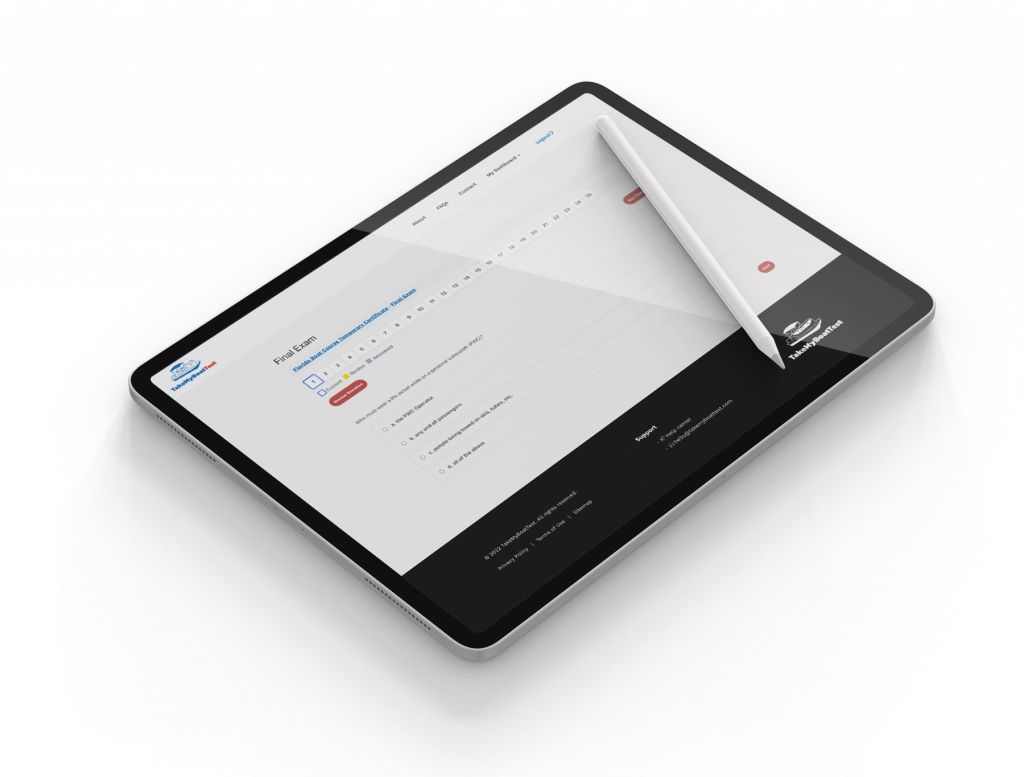
- Format: Online reading modules, videos, interactive diagrams
- Interactivity: Scenarios, real-world examples, quizzes within course
- Difficulty: Moderate (not a tricky exam, straightforward safety info)
- Atmosphere: Friendly, conversational tone (not textbook boring)
Study Tips: Take notes on key regulations (especially state-specific rules). Pay close attention to emergency procedures (they save lives). Understand navigation rules (prevents accidents). Memorize equipment requirements (coast guard will check).
Step 4: Pass the Final Quiz
Quiz Details:
- Questions: Typically 10-20 multiple choice
- Passing score: Usually 70-80% (varies by provider)
- Attempts: Unlimited (most providers allow retakes)
- Time limit: Usually 1-3 hours per attempt (rarely an issue)
- Difficulty: Straightforward (tests content understanding, not tricks)
Pro Tips: The quiz tests whether you understand safety concepts. Review the course material before taking the quiz. Don’t stress—most people pass on their first attempt. You can retake as many times as needed.
Step 5: Receive Your Certificate
Digital Certificate:
- Delivered via email (usually within minutes)
- PDF format
- Can print at home or display on phone
- Includes name, certificate number, issue date
- QR code for verification (authorities can scan to verify)
- Valid immediately in your state
You Can Now:
- ✅ Legally operate motorized vessels in your state
- ✅ Rent boats from rental companies
- ✅ Avoid $500+ fines
- ✅ Demonstrate legal compliance to authorities
Total Time from Start to Legal Operation: 1-2 hours.
Real Cost Analysis: Why Boating Certification is Worth It
The $39.97 Investment Protects You From:
Legal Risk: Fine for operating without certification: $500-$1,000+. Boating safety certification cost: $39.97. ROI: Avoid fine = 12x the certification cost.
Insurance Denial: Cost if insurance denies claim for operating without cert: $10,000-$100,000+. Certification cost: $39.97. ROI: Avoid denied claim = 250-2,500x the certification cost.
Liability from Accidents: Cost if you injure someone due to unsafe operation: $100,000-$1,000,000+. Certification cost: $39.97. ROI: Prevention through knowledge = priceless.
Rental Company Access: Cost of boat rental trip without certification: $0 (denied rental). Certification cost: $39.97. Boat rental revenue unlocked: $200-500+. ROI: One rental trip pays for certification 5-12 times over.
Safety Knowledge: Value of preventing accidents that injure or kill: Invaluable. Cost to gain that knowledge: $39.97. ROI: Priceless.
Ready to Meet Boating Safety Certification Requirements?
Your Action Plan:
- Determine your requirement: Florida or California? What vessel type?
- Choose your provider: NASBLA-accredited, state-specific (recommend TakeMyBoatTest)
- Complete the course: 1-2 hours online, at your pace
- Pass the quiz: Usually on first attempt with course review
- Get your certificate: Digital delivery within minutes
- Boat legally: Immediately valid, lifetime protection
Get Certified Now:
- Florida: TakeMyBoatTest.com — $39.97 Lifetime
- California: TakeMyBoatTest.com — $39.97 Lifetime
Key Takeaway: Boating safety certification requirements exist because knowledge prevents accidents. A $39.97 investment in safety education is one of the best decisions you can make before getting on the water.
Don’t skip this step. Your safety—and your wallet—depends on it.
FAQ: Boating Safety Certification Requirements
Q: Are boating certification requirements the same nationwide?
A: No. Each state sets its own requirements. Florida and California have specific age cutoffs and vessel requirements. If you boat in multiple states, check each state’s requirements. NASBLA accreditation is recognized widely, but state-specific content is important.
Q: What happens if I boat without meeting certification requirements?
A: You risk $500-$1,000+ fines, criminal charges, insurance denial, and personal liability. Marine patrol actively enforces boating laws. It’s not worth the risk when certification costs $39.97.
Q: Can I get certification without taking a course?
A: No. There’s no shortcut to certification. You must complete an accredited course and pass the quiz. The course exists to teach actual safety skills that prevent accidents.
Q: What if I’m only boating once—do I still need certification?
A: Yes, if you meet your state’s requirements. A single boating trip without certification can result in a $500+ fine. The certification lasts a lifetime, so one course covers all future boating.